
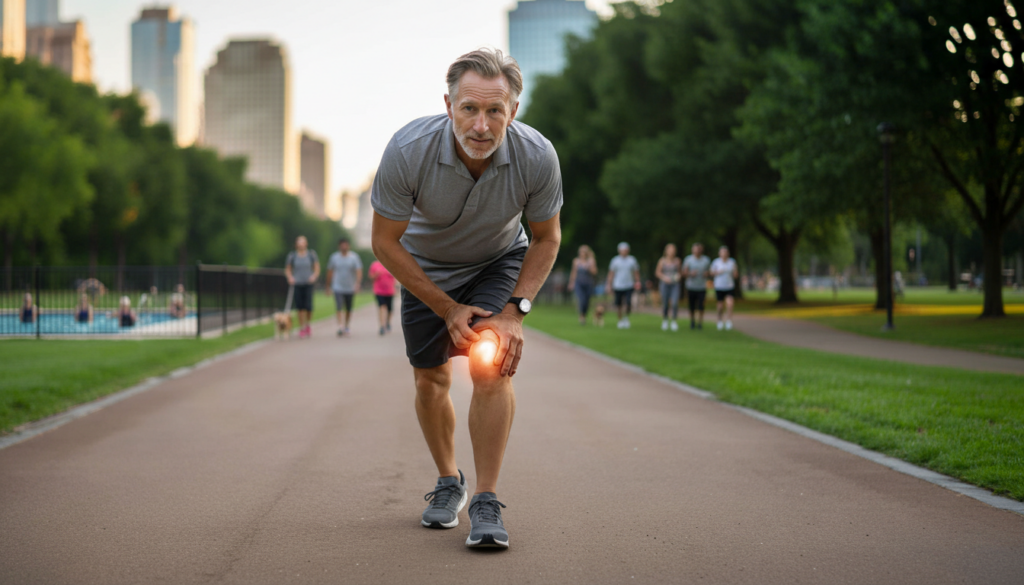
A man in his late 50s walks into the consulting room. He has one hand on his right knee, as if it might fall apart if he lets go. He sits down with a small groan, says he’s sorry for the noise, and then laughs it off like people do when pain has become a part of who they are. He has been swimming twice a week. He bought a Pilates package, but now it mostly just sits on his credit card as guilt. Every time he climbs the stairs, his knee hurts.
His doctor tells him one thing. His physiotherapist tells him something else.
And this week, a new study has quietly blown up the argument over what really helps sore knees the most.

Doctors disagree on the “best exercise” for knee pain as new evidence comes to light.
The same advice keeps coming up in clinics and WhatsApp groups with friends: swim to protect your joints, and do Pilates to strengthen your core and protect your knees. That’s been the safe script for a long time. Not a lot of impact. Gentle movements. Not too daring. Then, a group of researchers looked at a lot of people with knee pain and came up with a result that surprised even experienced doctors.

Swimming wasn’t the best activity for relieving joint pain. It wasn’t Pilates on fancy reformer machines either.
It was just a quick, easy walk.
A British rheumatologist put it this way: “We told people to stay off the pavement, but the pavement is actually part of the treatment.” The new study, which used data from older adults with knee osteoarthritis symptoms, found that those who kept walking regularly reported less pain over time and showed fewer changes in their knee structure on imaging. Not the distance of a marathon. Not poles for Nordic walking. Just normal steps that are a little faster than walking a few times a week.
Imagine a line of people in a waiting room. People who quietly say, “I walk most days, even if it hurts at first,” tend to have better days than people who proudly say they only swim.
So why would walking, which puts stress on the joint, be better than “kinder” options like water and mat work? One reason is the biology of the joint itself. Cartilage doesn’t have blood vessels that bring nutrients to it. It pushes joint fluid in and out like a sponge by moving, compressing, and decompressing. That gentle squeezing while walking seems to feed and stabilize the knee in a way that floating can’t fully do.
Swimming and Pilates are still great for building strength, improving posture, and overall fitness. They don’t really show how knees are used to move body weight through space in real life. That’s the problem for a lot of doctors.
The easy way to walk that is taking the place of swimming and Pilates
The people who wrote the headline didn’t tell people to climb mountains. It was surprising how modest their sweet spot was: about 6,000 to 8,000 steps on walking days, with a clear focus on 20 to 30 minutes of purposeful, brisk walking. Not the speed of window shopping. The kind of walk where you could talk but not sing. Enough to feel your legs working without hurting your joints.

Many of the people who took part broke their walks up into short parts. In the morning, I walked around the block for ten minutes. At lunch, I did another lap, and after dinner, I walked around the block again. This pattern seemed to work better for sore knees than doing something heroic once a week.
This is where it gets real. A lot of people with knee pain wait for a “good day” to walk, then they do too much, which makes the joint hurt again and makes them afraid and avoid it. We’ve all been there: the time you hurt your leg and promised yourself you wouldn’t work out for a week. The study quietly went against this cycle by promoting consistency over drama. More frequent, shorter walks, even when the knee hurts.
Let’s be honest: no one really does this every day. But the people who came closest—walking four or five days a week and resting or doing lighter movement on other days—saw the biggest change in how their knees felt in daily life.
A sports doctor I talked to talked about the tension in a very direct way.
“Patients come in and say, ‘My last doctor told me not to walk too much because I’m wearing out my knee.’ Then I have to explain that avoiding things isn’t what keeps the joint alive; smart walking is. I know it sounds like I’m disagreeing with a coworker, but the science has changed.
He now gives a small, boxed set of rules that are similar to what a lot of knee specialists are starting to say:
- Even if that means walking for five minutes, start where you are.
- For the first few weeks, walk on flat, even ground.
- Stop when you feel uncomfortable, not when you feel sharp or sudden pain.
- Add light strength exercises, like sit-to-stand from a chair, to your walking days.
- If you love your pool and Pilates, keep them, but don’t stay in them forever.
*For a lot of people, the hardest part isn’t even physical; it’s trusting that a little pain when moving isn’t always damage.*
What this knee debate really says about how we move, beyond the study
This disagreement about knee advice isn’t just an academic one. It shows that we have deeper problems with how we think about getting older. Are joints like fragile glass that need to be protected from the outside world, or are they living tissue that can handle the stress we put on them? The question is right in the middle of walking, which is so normal. It’s easy to get to, a little boring, hard to make money off of, and yet it quietly changes the story many people tell themselves about their pain.

Some people will see themselves in all of this: the pricey gym membership, the pool membership that isn’t used much, and the promise to “go back when my knee is better.” Some people will remember a parent, partner, or neighbor who says, “I just can’t walk like I used to,” and then starts to walk less and less.
| Key point | Detail | Value for the reader |
|---|---|---|
| Walking can ease knee pain | Regular, brisk walking (20–30 minutes, several times a week) was linked with less pain and fewer structural knee changes than fully low-impact options alone. | Gives a realistic, low-cost strategy that fits into everyday life without special equipment. |
| Consistency beats intensity | Short, frequent walks worked better than rare, long sessions or relying only on swimming/Pilates. | Helps readers design a routine they can actually sustain, even on “not perfect” days. |
| Pain doesn’t always mean damage | Mild discomfort while walking can be part of adaptation, while sharp or escalating pain signals the need to stop and adjust. | Reduces fear, encourages safe experimentation, and prompts timely medical advice when red flags appear. |
