
The stairs you see every day are ordinary steps until you choose to turn them into an excellent leg workout. That park bench might seem like a spot to sit and relax but you can use it for squats or step-ups to make your legs stronger. The floor in your living room that you cross daily offers more value than costly gym equipment when you commit to using your own bodyweight. You don’t need a gym membership or special gear. All you need is gravity and the decision to build strength using what you already have around you.
Strength Starts at Home: How Bodyweight Leg Training Truly Delivers Results
Stand barefoot in the center of a room and notice the floor beneath you. It feels cool, solid, and completely indifferent. Spread your toes and gently shift your weight from heel to forefoot. Your legs, already reliable supports, perform countless silent adjustments every day to keep you upright. This is where effective leg training without equipment begins — not with heavy bars or machines, but with the connection between your feet and the ground. Removing gym tools doesn’t reduce results; it removes distractions. What remains is honest movement. Squat, lunge, hinge, push, jump, and balance. These are timeless actions, older than gyms and workouts. Bodyweight leg training becomes a way to move through life with alert muscles, stronger joints, and a body that feels like a partner rather than a burden.
Waking Up Your Legs: Preparing Muscles Without Equipment
Before your legs work hard, they need to wake up. Not through frantic stretching, but through controlled, purposeful motion. A proper warm-up for bodyweight leg training only requires a small space and focused attention. Begin by marching in place for about a minute, letting your arms swing naturally while your heels tap the floor. Your heart rate gradually rises. Move on to slow ankle circles, one foot at a time, drawing careful shapes in the air. Gently bend and circle your knees, keeping everything comfortable and relaxed. Never force movement — instead, invite your joints into motion. Fold forward with slightly bent knees to wake your hamstrings, then ease into a few shallow squats. This warm-up isn’t separate from the workout; it’s the opening chapter where hips, knees, ankles, and balance prepare to work together.

Using Gravity as Resistance: Core Movements for Stronger Legs
Bodyweight leg training works best when treated like cooking with simple ingredients. A few fundamental movements, practiced with care, offer endless progression. You don’t need dozens of exercises. Squats teach controlled sitting and standing. Lunges develop balance and single-leg coordination. These patterns already exist in daily life — training simply refines them. Over time, these movements shape legs that are not only stronger but more capable in real-world situations.

Bodyweight Squats: Creating Strength from the Ground Up
Stand with your feet about shoulder-width apart. Imagine sitting back into a chair placed slightly farther behind you. Your hips move back as your knees bend, while your chest stays upright. Keep your heels grounded and your toes connected to the floor like anchoring roots. At the lowest point — whether deep or partial — pause briefly and breathe. Feel your quadriceps engage, your glutes activate, and your hamstrings stretch gently. Rise with intention by pressing into the floor. As squats become easier, increase difficulty by slowing the tempo, pausing longer at the bottom, or adding small pulses. Patience and control provide all the resistance you need.
Controlled Lunges: Building Balance, Stability, and Control
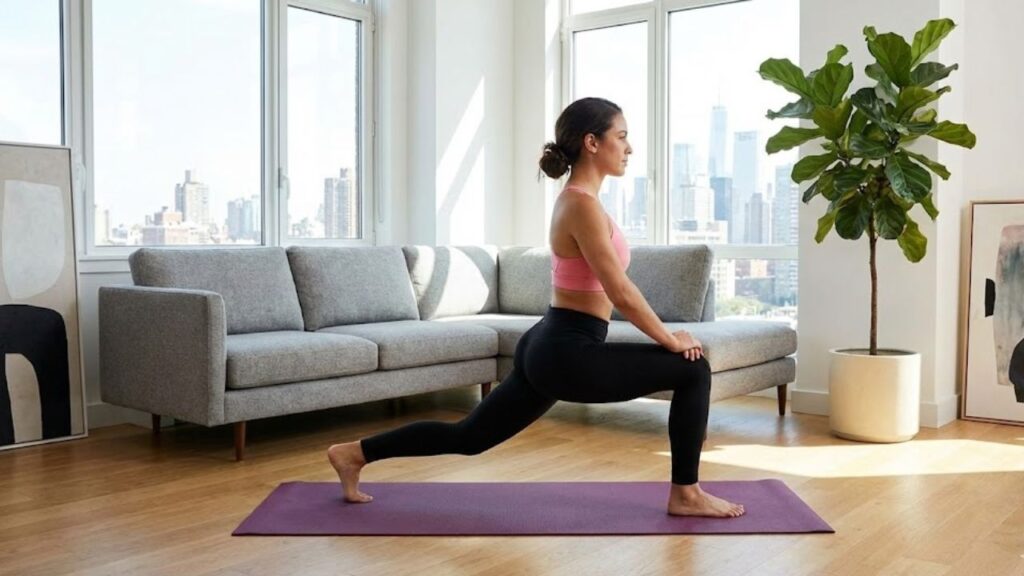
Lunges turn simple steps into deliberate strength work. Step forward as if preparing to kneel, bending both knees together. Your front knee tracks over the center of your foot while your back knee lowers gently toward the floor. Keep your torso upright and your gaze steady. Push through your front foot to return to standing. Alternate sides and notice how each leg feels. One may feel steadier than the other — this uneven feedback is valuable, not negative. Lunges teach your hips to stabilize and your knees to move correctly. Try walking lunges or reverse lunges, which tend to be knee-friendly. True strength shows itself in control, not just force.
Glute Bridges: Strengthening the Posterior Chain Naturally
Lie on your back with knees bent and feet flat on the floor. Arms rest comfortably at your sides. Gently press your lower back into the ground, then lift your hips until your body forms a straight line from shoulders to knees. At the top, squeeze your glutes and hold briefly before lowering slowly, one vertebra at a time. This movement activates the entire posterior chain, supporting your lower back and stabilizing your hips. As strength improves, progress to single-leg bridges to increase the challenge. Gravity and body awareness provide all the resistance required.
Calf Raises: Strengthening an Often Overlooked Muscle Group
Stand with feet hip-width apart and lightly touch a wall or chair for balance if needed. Rise onto the balls of your feet, lifting your heels as high as possible. Hold briefly, then lower slowly with control. Your calves act as shock absorbers and energy springs during walking, running, and climbing. Strong calves improve daily movement efficiency. Perform this exercise on flat ground or on a step to increase range of motion by letting your heels dip slightly before lifting again.
Step-Ups: Turning Everyday Surfaces into Training Tools
Use a stable bench, chair, or low wall. Place one foot on the surface and press through it to stand tall. Bring your other foot up, then step down slowly with control. The working leg engages from hip to calf as it lifts and lowers your full body weight. Step-ups mimic real-life actions like climbing stairs or stepping onto uneven ground. Any wobble signals an opportunity for growth. Increase difficulty by using higher surfaces, slowing the movement, or pausing at the top to challenge balance.
Progress Without Weights: Smarter Ways to Keep Improving
Progress in bodyweight training doesn’t depend on added equipment. Instead, it relies on adjusting repetitions, tempo, and leverage. Early progress might mean increasing reps or sets. Later, you can add jump squats, slow eccentric movements, or single-leg variations like assisted pistol squats. Slowing down a squat to a controlled count with pauses dramatically increases intensity. Changing angles — such as elevating feet during bridges or stepping deeper into lunges — creates new challenges. These subtle changes ensure continuous adaptation without weights.
Building a Simple, Effective Bodyweight Leg Routine
An effective leg routine doesn’t require complex planning. Choose a small group of exercises and perform them several times a week with focus and effort. Rest approximately 45 to 75 seconds between sets. Adjust repetitions to your ability, ensuring the final reps feel challenging but maintain proper form. As strength improves, add reps, sets, slower tempos, or more advanced variations such as jump squats, Bulgarian split squats, or single-leg bridges. Consistency and intention matter more than complexity.

| Exercise Name | Sets | Repetitions / Duration | Training Focus & Tips |
|---|---|---|---|
| Bodyweight Squats | 3 | 10–15 Reps | Movement ko dheere aur control ke sath karein, balance maintain rakhein aur neeche jaakar thoda pause karein |
| Reverse Lunges (Per Leg) | 3 | 8–12 Reps | Peeche ki taraf step lein taake knees safe rahein, chest upright aur body stable rakhein |
| Glute Bridges | 3 | 12–15 Reps | Heels par pressure dein aur top position par glutes ko achi tarah squeeze karein |
| Step-Ups (Per Leg) | 2–3 | 8–10 Reps | Strong aur secure surface ka use karein, neeche aate waqt movement ko control karein |
| Standing Calf Raises | 3 | 15–20 Reps | Heels ko poori tarah upar uthayein aur har rep mein thodi der top par hold karein |
From Living Room to Park Bench: Training Anywhere, Anytime
Once you notice it, everyday surroundings reveal endless training opportunities. A curb becomes a calf raise platform. A park bench turns into a step-up station. Stairs, sidewalks, and open spaces quietly invite movement. Try turning part of a walk into a workout: pause for squats at driveways, use benches for step-ups, finish with controlled calf raises on a curb. Bodyweight training blurs the line between exercise and daily life. Strong legs built this way are ready for hikes, long days on your feet, or spontaneous movement. Training without equipment isn’t a compromise — it’s a return to functional strength, grounded movement, and trust in what your body can already do.
